
Indonesia offers foreign brands a large market, but entering without local data is risky. This guide explains what to research before entry, where brands often go wrong, and when a local research partner may be more useful than a global network.
Indonesia offers foreign brands a large market, but it is easy to misread. The country counts roughly 284 million people, making it the world's fourth-most populous nation, according to Statistics Indonesia (BPS). That is a market bigger than the United Kingdom, France, and Germany combined. But population size alone tells you almost nothing useful about whether your product will sell, at what price, in which cities, or through which channels.
The mistake most foreign brands make is treating Indonesia as a single, uniform market, much like they might approach Japan or South Korea. In reality, Indonesia is an archipelago of more than 17,000 islands, over 300 ethnic groups, and hundreds of local languages layered underneath the national language, Bahasa Indonesia. A consumer in Surabaya does not shop, save, or respond to advertising the same way as a consumer in Jakarta, Medan, or Makassar. Investment into the country keeps climbing. Total investment realization reached IDR 1,931.2 trillion in 2025, with foreign direct investment making up 46.6% of that figure (IDR 900.9 trillion), according to Indonesia's Ministry of Investment and Downstreaming (BKPM). Companies are investing because they expect Indonesia to grow over the long term. Local research can test that expectation before a brand spends a year and a large budget treating Jakarta as a stand-in for the whole country.
In short
- Indonesia's population and economy are large enough to reward patience, but its regional, income, and cultural diversity make a single national strategy risky without local data first.
- Jakarta is not a stand-in for the rest of the country. Consumer behavior, purchasing power, and language preferences change by region and city tier.
- Effective pre-entry research covers consumer behavior, competitive mapping, high-level regulatory considerations, pricing sensitivity, and concept testing with real local consumers.
- The most common and costly mistakes are assuming Jakarta represents Indonesia, translating messaging word-for-word instead of adapting it culturally, and misjudging what local consumers are actually willing to pay.
- A local research partner with fieldwork teams in Indonesia can work faster and at a lower cost than a global network alone. Both options can be valid, depending on the project.
Why Indonesia offers opportunity and risk for foreign brands
Indonesia is Southeast Asia's largest economy, and its consumer base is large, young, and increasingly connected. Internet penetration reached 80.66%, or roughly 229 million users, in 2025, according to the Indonesian Internet Service Providers Association (APJII). That scale is why so many foreign brands see Indonesia as the next logical market after Singapore or Vietnam. It is also why entry mistakes are so expensive: a market this large has enough regional variation that a strategy built on assumptions can fail in one city while quietly succeeding in another, and a company without local research has no way to tell the difference until it is too late.
Investment inflows show that Indonesia is open to foreign brands. The difficulty lies in distribution across islands, a retail market split between traditional stores and modern e-commerce, and consumer preferences that change by region. Foreign brands need local data about their buyers before committing capital to a launch.
Why Indonesia needs a different market entry plan
Executives who have successfully entered other Asian markets often assume the same playbook will transfer to Indonesia. It usually does not, for four reasons.
Regional diversity across islands
Java, home to Jakarta, holds roughly half of Indonesia's population, but the other half is spread across Sumatra, Kalimantan, Sulawesi, Bali, and thousands of smaller islands, each with different income levels, retail infrastructure, and consumer habits. A distribution and marketing plan built only around Jakarta will miss most of the country.
Income disparity
Purchasing power varies sharply between urban centers and secondary cities, and even within a single city between neighborhoods. A price point that performs well in South Jakarta may be entirely out of reach in a mid-sized provincial capital, which directly affects packaging size, price tiering, and channel strategy.
Bahasa Indonesia and local language nuance
Bahasa Indonesia is the official language, but everyday communication is layered with regional languages and dialects, plus a fast-moving mix of slang and code-switching with English, especially among younger urban consumers. A message that translates correctly on paper can still miss the tone that makes it land.
Religious and cultural considerations
Indonesia has the world's largest Muslim population, and religious practice shapes everyday consumption. It affects halal certification expectations in food, cosmetics, and pharmaceuticals, along with seasonal spending around Ramadan and Eid. Brands that do not account for this in product formulation, packaging, or campaign timing are starting from a disadvantage before launch.
What to research before entering Indonesia
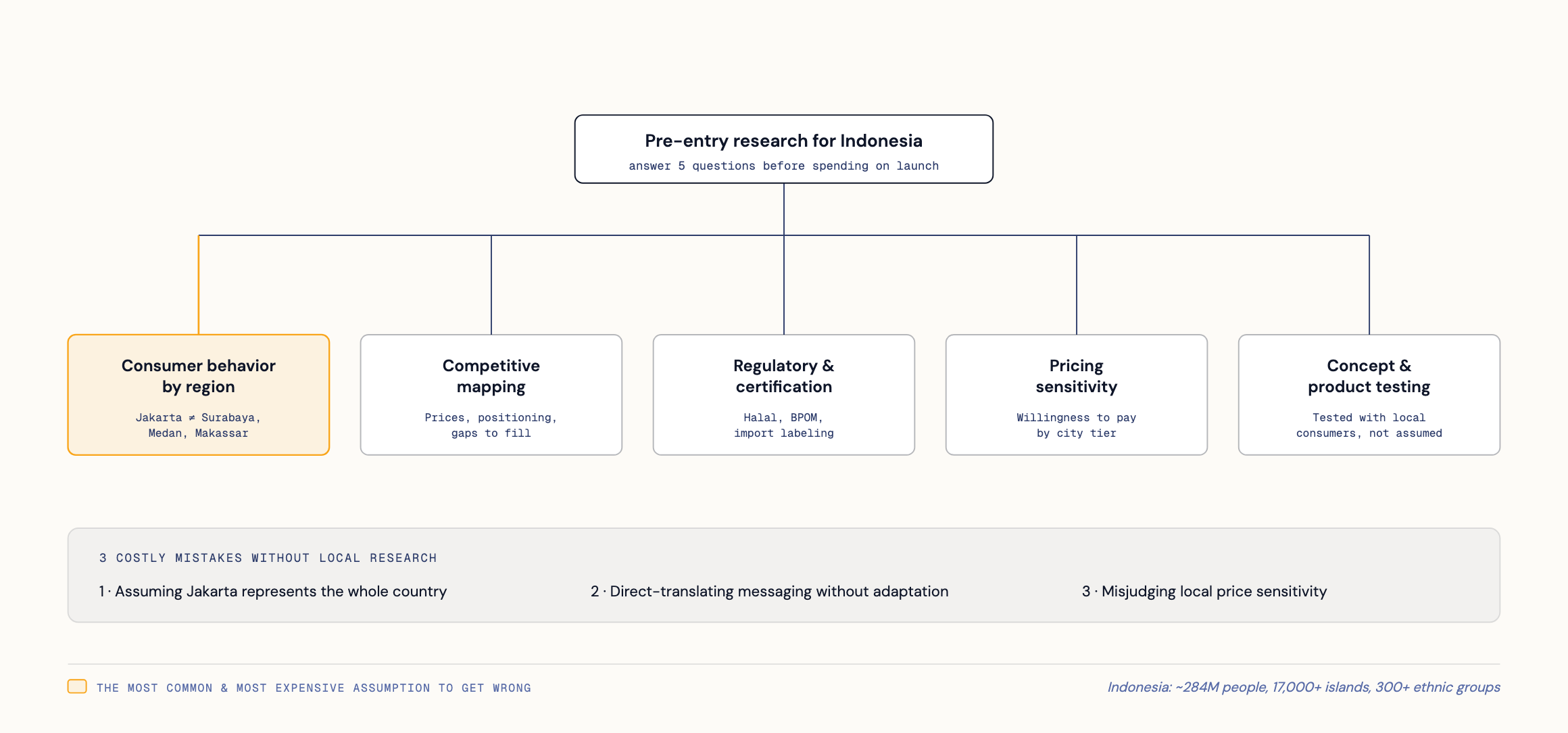
Before launch, market research should answer five practical questions.
- Consumer behavior and purchasing power by region. How do target consumers in Jakarta compare to those in Surabaya, Medan, Bandung, or Makassar in terms of income, spending priorities, and shopping habits (online or offline, and modern trade or traditional markets)?
- Competitor mapping. Who already serves this category locally, what price points and positioning do they use, and where are the gaps a new entrant could credibly fill?
- Regulatory and import considerations at a high level. What certifications, labeling requirements, or import classifications (such as halal certification or BPOM registration for food, health, and cosmetic products) will affect timeline and cost? This is not a substitute for legal counsel, but research should flag these issues early enough to plan around them.
- Pricing sensitivity testing. What price ranges are local consumers actually willing to pay, and how does that shift by city tier and income segment? This is frequently where foreign brands overestimate the market.
- Concept and product testing with local consumers. Before a full launch, does the product concept, packaging, or messaging resonate with Indonesian consumers when tested directly, rather than inferred from another market?
Common mistakes without local research
Brands that skip local research or rely only on secondary data often make the same mistakes.
Assuming Jakarta represents the whole country. Jakarta is the natural starting point for market entry, and it is genuinely useful for a first read on a category. But treating Jakarta consumer data as representative of Indonesia as a whole overstates income levels, understates religious and cultural influence on purchasing, and misses the retail dynamics of secondary cities where much of the country's future growth is expected to come from.
Translating messages without cultural adaptation. Marketing copy translated word for word from English or another Asian market often sounds stiff, overly formal, or off-tone to Indonesian consumers. Cultural adaptation uses local idioms, humor, and references from the start.
Misjudging price sensitivity. Brands that price based on their home-market cost structure or on assumptions borrowed from other Southeast Asian markets frequently launch too high for the segment they are targeting, or too low to be credible in a premium category. Local pricing research before launch avoids both errors.
When to work with a local research partner
Global research networks are a sound option for multinational programs that need the same methodology across a dozen markets for strict comparison. For a company focused on Indonesia, a local research partner can offer several practical advantages.
Fieldwork outside Jakarta. A local team already has fieldworkers, moderators, and recruitment networks in secondary cities, not just Jakarta. That matters because some of the most useful market entry data concerns how consumers in cities such as Medan or Makassar behave. An outside team may take longer to reach those consumers reliably.
Cultural and language context. A local researcher catches the difference between a Bahasa Indonesia phrase that sounds natural and one that sounds translated, or a survey question that reads as neutral versus one that carries unintended religious or cultural weight. That nuance shapes both data quality and how confidently a brand can act on it.
Local operating costs. Local fieldwork, respondent recruitment, and project management generally cost less than routing the same work through an international network's Indonesia office. Local teams also know which recruitment channels and methods work in this market.
Common questions
How different are consumers in Jakarta versus other Indonesian cities?
Jakarta consumers generally have higher disposable income, more exposure to international brands, and heavier e-commerce usage than consumers in secondary cities. Purchasing power, price sensitivity, and even language style shift as you move to cities like Surabaya, Medan, Bandung, or Makassar, which is why research limited to Jakarta tends to overestimate national market potential.
Do I need local research if I already have data from other Southeast Asian markets?
Usually yes, at least for the specifics of pricing, messaging, and regional variation. Regional Southeast Asia data can be useful for category-level context, but Indonesia's scale, religious composition, and island geography make it different enough from Vietnam, Thailand, or the Philippines that consumer behavior assumptions rarely transfer cleanly. Regional data works best as a starting hypothesis that is then tested in Indonesia.
How long does market-entry research in Indonesia typically take?
It depends on scope, but a focused program covering consumer behavior, competitive mapping, and concept or pricing testing can typically be completed in a matter of weeks rather than months, especially when working with a local partner who already has fieldwork infrastructure in place. Broader, multi-city studies with extensive quantitative components take longer.
What is the biggest risk of skipping local market research before launch?
Launching with a price, product configuration, or message that was validated somewhere else but was never tested against actual Indonesian consumers. That mismatch may remain invisible until after launch. Repricing, reformulating, or changing the message then costs far more than testing it beforehand.
DEKA Insight has helped brands study Indonesian consumers since 1995. Our work includes fieldwork across major cities and regions, consumer and competitor research, pricing, concept testing, and post-launch tracking. Learn more on our about page, or get in touch to discuss a market-entry research program for Indonesia.
Interested in research for your brand?
DEKA Insight helps Indonesia's leading brands make better decisions with actionable consumer insights.
Get in Touch